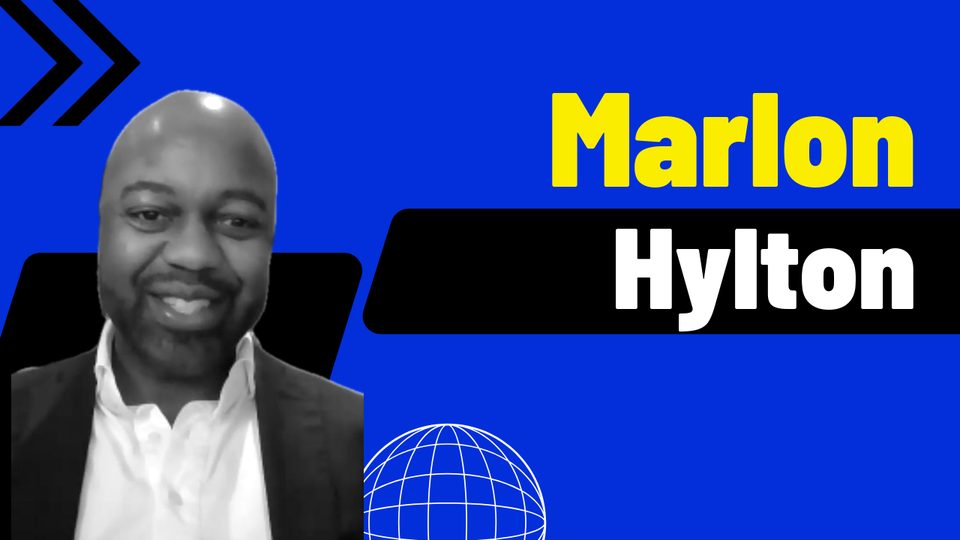
Marlon Hylton
on Jamaicans, achievement in law, electronic records, and the future of e-discovery
The podcast version. It also plays in any podcast app.
Transcript
5,587 words · about 24 min to readMark the passages that stay with you: press the number beside a paragraph. Marks are anonymous, and the most-marked passages help choose what goes into the book.
To hear a passage, press ▸ under its number; it plays just that paragraph.
See a misspelled name or a wrong word? Select it and press Report an error, or email the correction. The transcript is machine-made; corrections are welcome.
Hello, this is another episode of The Yunusov Question, and I have a wonderful guest today who will talk to me about eDiscovery, data law, big data, and many other interesting things. We were classmates at Osgoode Hall Law School. Marlon Hylton, everybody. Hello. Hello, Marlon.
Hey, Pulat, thank you for inviting me. Happy to be here.
It's my pleasure. So, ex-Cassels partner, ex-McCarthy's lawyer, eventually you founded your firm that has to do with e-discovery, with data law, with big data. Is this a fair brief intro of who you are in the legal profession?
It is, it is. We really focus on helping our clients with the challenges that we know people face around using data in legal proceedings. Broadly speaking, that's what it is.
I can't wait to dig in the data questions, and I can't wait to dig in to talk more about your firm. I'm really interested in the subject. As you know, we already had discussions about it, but before we get there, let's talk about who you are as a person. I know that, like me, you were not born in Toronto. Tell us where you're originally from.
I'm from Jamaica, what Jamaicans affectionately refer to as The Rock. Proud Jamaican, came to Canada later actually in life. I'd already done a fair bit of schooling in Jamaica. I was a teacher for a bit, came to Canada at 25 years old.
You are a Jamaican. There is another famous Jamaican that I know, and it's not Usain Bolt, it's Shaneka Shaw.
Shaneka Shaw, my very good friend.
Yes, and my friend. So we shared lockers in Osgoode. I don't know if you knew that.
No.
And she's also a superachiever like you. So what is it about Jamaicans that helps them, that drives them? I know quite a few of them that achieved a lot, that are really reaching for the stars. Is it the fact— so unlike other immigrants, is it the fact that English is the first language in Jamaica? Is it something else? Tell me more about the Jamaican achievement.
I think it goes probably well beyond a language thing. I think, you know, I'll start with what happened in my house as a Jamaican kid, and there was always a big emphasis on education and working hard at that, because that's really sort of the only alternative that was presented to you as a means by which to to rise, right? And I think if we expand out, I think on a macro level in Jamaica, that was true for most families in Jamaica. Understanding that it's a country where the majority of the population is poor. There's a very small middle class. So there's a huge emphasis on the need to excel and to advance socially among most of that population.
So even if you yourself aren't, you yourself are a part of that tiny middle class, everything else that's present in the countries is so in your face, you cannot move without seeing it. And I think that contributes a lot to the ambition and the drive that you see in many Jamaicans.
When did you come to Canada?
I came in 2000.
So did I. I also came to Canada in 2000. We came to Canada in the same year. Tell us about your path to law. How did that work out? Why law? Did you want to be a lawyer from childhood?
You know, that's, that's, that's an interesting question, right? Because I took sort of a circuitous route to something I'd always want to, to do. So picture this for a second, right? You're, you know, between, I'd say, 2 and 7 years old. The same year I was born, my parents had a car accident and it left my dad quadriplegic since. So I've only known him, you know, in that way. And as a result of that accident, he had some legal issues to deal with over the early years of my life. Life. And his lawyer, a guy named Douglas Brandon, he's now passed away, but such a fantastic guy. My dad would take us whenever he went to visit his lawyer.
And that guy would pick me up, bring me up to his desk, and, you know, read bits and pieces of stuff he had on his desk. And he used to say to my dad, you know, you save up some money to spend on this one. He's going to be a lawyer like me. And for some reason, you know, that, that just stuck. I thought, I want to be you. I think that's a great idea, even at that age, and thought that's, that's what I wanted to do.
Amazing. And did you know you would be in Canada? Was it your decision to come to Canada? Was it your parents' decision?
It was my decision. I, you know, I'd gone to— so talk about the circuitous route to law. In the Caribbean, you know, the options for getting legal training is quite limited. There is at the time just— there was only one law school serving the entire country and really the Caribbean. It was competitive and it was really expensive, not something my parents could have afforded. And so I chose to go to Teachers College instead. Which was subsidized by the government. It was the only sensible option that was available, so I did that. Excuse me. But knew that wasn't the last stop, right? I remember I said at the outset how big a deal education was for my father especially.
And with that planted so firmly in my head, I knew I was going to go on to to, you know, further studies. And thinking about that, I thought going on to further studies in the Caribbean may be a little bit more restricting than I want to be. So I looked at the US, again quite expensive. My brother lived in Canada. I have a half-brother whose mom is Canadian, so he grew up with us and then he was living in Canada. Towards the end of his high school years. So I'd been to Canada a few times before, visited York University, and decided to apply there because, you know, it was familiar. I already knew some people here.
I had cousins here as well, and it wasn't as expensive as the US,
right? You know, you went to Osgoode Hall Law School. You know, let's call a spade a spade. It's considered to be a really good law school. Then you continued the blue chip path. You became a McCarthy's lawyer, you practiced law at McCarthy's, you went to Cassels, you made partner at Cassels. So this is a pretty blue chip path that you took, but it strikes me that even on this blue chip path, you carved your own path. You pursued a path that is different from the traditional law practice path. Project management lawyer at McCarthy's, head of discovery management while being an associate at Cassels. So what, what is it, what is it about that?
Did you craft that yourself or someone guided you, someone held your hand, someone had a great mentor who showed you the path? How was— was it the combination of the two?
I think I go back again to my upbringing and the way in which I experienced the early years of life. Going into law school, I was never tied to any particular idea or picture of what my career or my practice should look like, how it should evolve. I had one basic idea and that was to do the absolute best that I can do with the thing that makes most sense for me in the time in which I'm pursuing it. So really that was all the decision that I actually consciously made. And you talk about blue-chip path but You know, there's a lot about the Path that wasn't blue chip. I remember going through the summer OCIs and summer interviews and trying to find an articling position, and that was a grueling, really daunting experience.
So OCIs for summers, I was never one to interview very well. And there are all kinds of reasons for that. You know, I was at that time king of the imposter syndrome. I felt like I didn't belong in law school. I felt like I was just different from everyone else. I'm just this Jamaican guy, like, you know, yeah, I'm ambitious and I know like I can do it. But in my head, everyone else thought I couldn't do it, or everyone else thought I didn't belong, you know. And be that as it may, it really did get in the way of things like delivering a great interview at the time. In any event, you know, you talk about great mentors, and I'm going to name her here, Angela Swan at Aird & Berlis.
Wow. 60 reference letters for me in one day. 60. Six-zero. Took her time to do that. Eventually I landed an articling position at Hydro One in-house. Did that, did it well. There was a secondment piece of that that was at Fasken Martineau. Did that, and it was while I was doing that that this eDiscovery data piece came across my radar. And remember now, I'm just open to whatever opportunity makes the most sense. I'm going to take that and I'm going to do the best I can with it, right? And at the time I saw, you know, people were collecting emails from— collecting emails, printing them out, and then later had to scan them back in for the lawyers to have them to review and assess.
And I thought, this cannot make any sense. The thing originated electronically. So why, why are we doing that middle piece? Right. So I started to look at the US, what's going on there. And I identified at the time, a few lawyers who were really developing nice practices around electronic evidence in litigation. And that's where I decided, I think this is what, this is what I'm I'm going to do. After articling, I started doing some contract work with Susan Wortzman and Susan Nickle, who at the time had started a law firm focused on eDiscovery. So that's sort of how that started. And within less than a year of doing that with Susan is when I went to McCarthy's.
This is an amazing story. I'm just quickly looking at Angela Swan because I remember her. She was a prof.
Yeah,
At Osgoode, and she's— I think she's the leading one of the probably very few leading authorities on contract law. Canada. And did she recently get an Order of Canada?
She did, she did, she did,
right? I wasn't wrong, I was just quickly Googling that. So she's an amazing person, an amazing lawyer, an amazing professor, legal scholar, and she was your champion. This of course helped you. I'm also hearing how it helped you really overcome that bump, the imposter syndrome. And then after that initial push, which was indispensable, I think you— what I'm hearing is basically you just felt free. And at that point, you just felt like you could choose your own interest and direction. And the— what I'm hearing is you just said 'Okay, I'm gonna do data law, I'm gonna do e-discovery because why are lawyers doing it this way?' Is this a fair read of what happened?
So you needed that push and when you got that push, you sort of blossomed at that point.
That's exactly right. And the further along the journey I went, you know, the more confidence you develop and, you know, the more you fine-tune where it is that you really, really want to see yourself go. So absolutely that push was necessary and the push went well beyond just 60 reference letters, right? You know, people like Angela Swan, like Ed Waitzer, taking time out to have those lunches, have those coffees, We're really in a mentoring profession, right? And people like you are just really important to have around, even to be able to bounce ideas off of, right?
And of course, Ed is another great guy who recently appeared on the show thanks to you because of your introduction. I really appreciate it. So I want to talk about eDiscovery. You are the guru today. We just heard about your early years, but we have to tell the audience that it's been 10 years since then, right? 10, 11 years, maybe about 12 years even, right? So you're now a guru in, in this field, and I want to start with a very simple question: is eDiscovery only for big firms?
Absolutely not. So, so think about it this way. EDiscovery is, as the title says, it's the discovery of electronic documents. In the old days, we only had paper. And so it was simply discovery, documentary discovery. It still is documentary discovery, except these days, you know, the majority of the documents you're dealing with are electronic documents. And so eDiscovery today is for every file. It boils down then to how you apply the principles and the tools of eDiscovery to the particular file. That's the piece where there's a big gap I find still in people's understanding and even in the approach to to discovery. There are ways of applying those principles to any file, irrespective of the size.
You just need to figure out the best tool to use and how best to proportionally approach that file in the context of the rules.
Right. And of course, in 2019, just before the pandemic, You founded your own firm to deliver these services to law firms and other stakeholders. So the firm is called INNOV-8 Data Counsel, and then there is also a consulting business, if I understand it correctly, called INNOV-8 Legal Inc. These are two separate entities, right?
Yes, we operate together to deliver the services.
Okay, so When you founded this firm, when you founded your eDiscovery shop, were you aiming only at large firms or were you also interested in servicing smaller firms and medium-sized firms as well?
So in the first place, the aim wasn't to create an eDiscovery shop. And, you know, by 2019, When I left Cassels and INNOV-8 started, in my mind, eDiscovery remains sort of a narrow, a very narrow niche applicable to certain kinds of legal proceedings. But the skills you develop and the principles that apply to eDiscovery is transferable to almost any legal proceeding in which you're handling data. And so that really was the aim. It's creating a shop that can be there for lawyers so that we can practice more efficiently using the right tools when we're dealing with data. Don't care what the legal proceeding is. Don't care if it's an invest— investigation or a piece of litigation or, you know, you're dealing with a large volume of contracts, it really doesn't matter because a lot of those principles, those rules, and selecting the right tool and doing that efficiently at the right price all applies.
And so that's what our shop focuses on. Now, who— your question really is who was the intended target? And the answer is we are really focused on those corporations and those law firms who don't have the resources or for whom it doesn't make sense to make the big investment in having these services internally. We've put together sort of the best-in-class technology. We have some great people. We have standardized processes that we've pull together and developed over the years. Each person at INNOV-8 coming with, you know, solid Bay Street experience, Big Four, large Bay Street law firm experience. And what, what we do is make that available to any firm or any company who needs these services and don't have those capabilities internally.
Right. You talked about paper, and you talked about how discovery used to be about paper, because humanity kept its records on paper for millennia until relatively recently. And then when electronic records emerged, litigators had to deal with eDiscovery or started having to deal with eDiscovery. So tell us, tell our audience, what is it about electronic records? What is it about them that makes them so different that you need specialized services to cope with it, such as those services that are offered by your firm?
So electronic records, unlike paper, the sheer volume that we're dealing with is very different from the volumes of paper that we used to deal with. Before, you know, we had, you know, 5, 6, 10 bankers boxes. It was finite. We knew where everything was. And so our old process worked really well. For electronic records these days, one, often we don't know what we have, we don't know exactly where it is, and we don't necessarily know or have the tools to gather that in the way that the boxes of paper would have pulled things together and made it available to us. The other thing is, that electronic records are easily changed. Simply copying a record or moving it in a particular way can change the properties of that record.
And so, you know, those are a couple reasons why it's different today. You need to know how to identify what records may be relevant to a piece of litigation or investigation or relevant to whatever the issue is that you're dealing with. You need to understand how to properly preserve that, which is very different in the paper days than it is today. How do you preserve electronic records that maybe may reside in very different systems across your enterprise? And then collecting that, how do you— it's very different than picking up a banker's box than having to gather up a bunch of emails and a bunch of loose electronic documents from SharePoint or a shared folder that you have in your department.
It's a very different process. And that must be handled with care to avoid things like spoliation, which you know quite well about. So that's really the reason. And I'll add to that too with— guidelines and principles like our Sedona Canada principles, which by the way are incorporated into our Ontario rules by reference, being able to properly discharge the obligations you have in relation to electronic documents following principles like that and complying with the rules can become quite complex in some cases.
How is it relevant to you know, an average Superior Court action, you know, under $1 million at stake, you know, maybe 100 documents, maybe 500 documents. How is it relevant to that? So if you are a lawyer of record in a Superior Court action like that, if you're acting for the plaintiff or for the defendant, What is one thing that you should keep in mind about eDiscovery, even if the word eDiscovery will never come up in the course of this action?
I'm sorry, so let me— give me the scenario again. What type of action is it?
It's just a regular action, pretty vanilla, you know. Let's call it— let's say it's a real estate dispute. Someone didn't close a residential real estate transaction, you know, there are some PDFs of offers and some agreements of purchase and sale. Maybe they're marked up with pen a little bit with initials, or maybe there is a Schedule A and Schedule B, and then, you know, the usual real estate residential transaction stuff. And then maybe some emails, some text messages. Of course, the first step in the discovery process is the affidavit of documents. I don't think that lawyers who act for parties in disputes like that think about e-discovery at all. E-discovery is referenced by the Rules of Civil Procedure.
The Sedona Principles, I think, are referenced by the Rules of Civil Procedure. But I don't think that ordinary lawyers who deal with relatively small disputes think about eDiscovery, but they for sure deal with electronic records, especially now when people don't really meet in person anymore. So what do you think is one thing, one skill, or one piece of knowledge that they definitely need to have about electronic records? What do— or maybe you can tell us what mistake you consistently saw lawyers like that make with respect to electronic records in your experience?
I'd say there are two really important principles that any lawyer handling discovery must bear in mind, irrespective of the size of the case or complexity of the case. And those are proportionality and defensibility. Understanding what, what's proportional in the particular case, and then what constitutes defensible steps taken to discharge the discovery obligations. Once you understand those two principles, you're well on your way to right-sizing your discovery effort for your particular case. Now, with, with respect to the mistakes that, that we see Those are many, and they include things like getting the client from their email to forward on, so forward on the email, their emails one at a time to counsel. Counsel then has to take those emails, review them.
What happens then when counsel is printing out those emails? You are counsel, pull that, you know, the email address at the top and the time and date sent of that email is of the person sending the email to you. So now you're in a position to have to redact that if you want to get rid of that before you produce that to opposing counsel. You know, there are things like, you know, printing out electronic documents, for example, in order to review them. If you get beyond a certain volume, that becomes really problematic. Keeping electronic records as electronic records makes search and retrieval a lot easier than it is if you've printed things out and then you have to scan those in, or you've scanned things in and not objectively code certain information on those records.
So those are a couple sort of big mistakes that people make. Even in small cases, there are simple things that you can do to make the process a little easier. Combining documents, for example, the entire production is combined into one single multi-page PDF document. When that reaches opposing counsel or you yourself receive such a production, that's more difficult for you to deal with, even, even if the case is small. And, and when you— once you go beyond that to, to examinations and, and then potentially to trial, it becomes harder to deal with those documents in the way you need to deal with them going forward in your, your piece of litigation.
There is a class of electronic records that are kind of stealthy. For example, browsing history. So the party may not even be aware that they created these records in the course of certain activity. How do you handle that? So lawyers, I don't think that lawyers are more educated necessarily about electronic records or digital issues more than an average Joe, right? So how do we educate people about types of electronic records knowing that some of them are stealthy, some of them are not obvious, some of them have no parallel in the paper world. Because you know how lawyers think often, they just transplant ideas from the traditional world into the digital world and look for analogs, for synonyms.
So some records in electronic— in the electronic world are completely different. They are unique. They are original. They don't have any analog in the paper world, and they're stealthy. So how do we tell lawyers about these records? Lawyers and specifically clients, rather, not lawyers. Clients have an obligation to disclose all relevant records, but they may not know that the class of records exist. But then the lawyer has an obligation to tell the client what records may be relevant. So are we now here talking about a duty to know more about electronic records than an average Joe, a duty to be digitally literate to a much higher extent? Are we talking about that now?
There are jurisdictions where, you know, these competency obligations have been expanded explicitly placed on lawyers in relation to technology. That's, it's not so explicit in our jurisdiction as it is elsewhere. But I think you're right, that is what we're talking about. And compounding that is COVID and the mushrooming of new data sources, new sources of evidence, new pieces of, data or information or material that could be potentially relevant to litigation coming out of, you know, online conferencing platforms, chat platforms, you know, Slack, the greater use of Slack. People are working from home, you know, remote technologies. There's a whole mushrooming of rich sources of evidence that can be overlooked if we're not turning our minds to them.
And to your question about, you know, how do we educate people, that's a very good question because one, you can make all the effort you want to educate people, it's not as effective if people don't wish to be educated. And so One way that I think about this is that this whole area of dealing with electronic evidence is increasingly becoming sufficiently complex to encourage more, more specialization by lawyers in this space, and the Bar getting more of an opportunity to have resources on which, on which we can lean for this kind of expertise, which is becoming only more and more important and more and more complex as we go forward. So a part of the question, yes, is education of the entire bar.
But a part of the question is— a part of the answer is also how do we continue to develop our young lawyers with this kind of specialization How do people like me make sure that I, you know, make myself available to mentor and develop young lawyers, young litigators to develop this skill set? It's tough to find a lawyer who's a really sharp lawyer, but, and also great at this technology piece and is able to be that bridge between what needs to happen on the technology side and what needs to happen from a legal perspective. Really difficult to find, and we should be encouraging more young lawyers to develop that expertise.
You know what I would love to see come out of your firm? I would love your firm to organize some CPDs. You got the expertise, you got the charisma, you got the connections. You need to do that, Marlon.
CPDs, Pulat. So we have lots of CPDs. I'm not as active anymore as I used to be on the Digital Evidence and eDiscovery Working Group in Ontario. We used to be the electronic— the eDis— we used to be EIC, the eDiscovery Implementation Committee in Ontario. That group runs CPD. You know, there's a big eDiscovery conference every year around November. The OBA sometimes in conjunction with, with DEED, runs conferences or, you know, CPD events. And there was a time I can remember around maybe 2018, '19, '20, when we were sitting down and thinking, there are a lot of CPDs out there and people aren't really making use of them as much as we think they should.
It's always the same people at these events and it's already the people who already know what's going on.
Yeah,
so CPDs, I'm not sure. It certainly has its place and should continue, but I think something more out of the box is necessary. Of course, whatever it is would offer CPD credits because that will encourage lawyers to take it, but the usual sort of seminar idea where you come and you sit down and you talk about eDiscovery issues, I'm not sure is as effective in our, in our current environment as, as it could be. And I don't think it certainly won't get us to where we need to be in terms of education of the bar and, and, and raising the competence of the bar in this area.
Right. So I understand what services your firm provides to large firms. So let's say a large firm doesn't want to invest in its own in-house data law or eDiscovery department, they will simply outsource it to your firm, or they will consult your firm about large projects involving millions of records or something like that. Does your firm offer any services to solo practitioners? Is your firm useful to small firms? Talk, talk a little bit about that.
That's, that's a question we, we continue to explore ourselves internally. I think the short answer is yes. But with, with that comes a bit more vigor is necessary around that proportionality question and that defensibility question and selecting the tool. You know, the workhorse of the industry is Relativity, the tool that most practitioners would use in this space for document review, even earlier in the process, you know, for processing and dealing with electronic records. Sometimes our cost on some of those tools make it prohibitive for us to properly service like a solo practitioner in the way that we believe they ought to be serviced. So there's a little— it's a bit more involved to get the right combination of tools and processes and getting that affidavit of documents done in that case, or even beyond that, supporting that practitioner beyond that.
But the answer is yes.
Where do you see yourself and your firm in 10 years? And after you answer that question, or maybe as part of answering that question, tell us where you see the eDiscovery and data law in 10 years.
So if you ask me this question in February of 2020, I would already be in the middle of the answer and, you know, pontificating on where things might go. And, but when, when we launched INNOV-8 in February of 2020, COVID happened a few weeks later. Even with a crystal ball, I might not have been able to anticipate that. So with this big event that we've just experienced, there's some influence on that, that has some influence on the answer that, that I would give to that question today. And when you first asked that question, the first thing that flashed into my mind is I barely see further out than 3 years at this point, let alone 10.
Who knows where this COVID situation will take us, right? Because I think it's going to be with us for a very long time. So where do I see INNOV-8 going in the future? We have developed a really focused, phased approach to how we're rolling our services out. We've gone through our first phase so far, which was to work with a select group of clients to really fine-tune what it is that, you know, fine-tune the offerings, work out the kinks, and then after that, we're looking at expanding that to the rest of the market in focused on Canada. And the areas in which we are really focused are on the eDiscovery space, particularly just end-to-end from the point at which we're helping clients to think about how to preserve what might be relevant to a piece of litigation, you know, the whole legal hold process, making sure that's properly done, collecting the records, getting them analyzed using the fantastic technology that we have available to us today throughout that process up to presentation in court should it get there.
And then we're focused on the commercial side on contracts. So helping typically large corporations with organizing, analyzing, tracking the risks involved in their contracts. And we're getting involved from as early as the drafting and negotiation of contracts. You may remember Salim Darsi, who was also at Osgoode with us. He's leading the charge on that and doing some fantastic work there. We're focused on the FOI space, freedom of information space, you know, automating a lot of what goes on there. Delivering a better product for clients at the right price. In data breaches, getting the review done with purpose-built technology, you know, and getting those notifications done in a timely manner and ensuring compliance. So we've selected our areas of focus, and we're emphasizing those, pushing those forward.
So that what I described there should take us to, you know, 3 to 5 years, 3 to 5 years out. And then beyond that, it really strategically is gaining market share and developing this bigger idea of here's a law firm and a technology company it controls that can step in and assist you with managing your risk, dealing with your data in any legal proceedings, or even on the business side. You have certain business decisions to make, you have tons of data to go through. Sometimes it's the same tools, but often it's the same principles that you're applying to get that information from the data. So there's lots on the roadmap without getting into too much detail, but You know, we're excited and looking forward to it.
Marlon, I wish you and your firm all the best. I really enjoyed this conversation, just like any other chat with you. It's been a lot of fun. I'm really interested in the topic, and you are the guru. Thank you so much, Marlon.
Thank you, Pulat. It was great being here, man. Thank you.