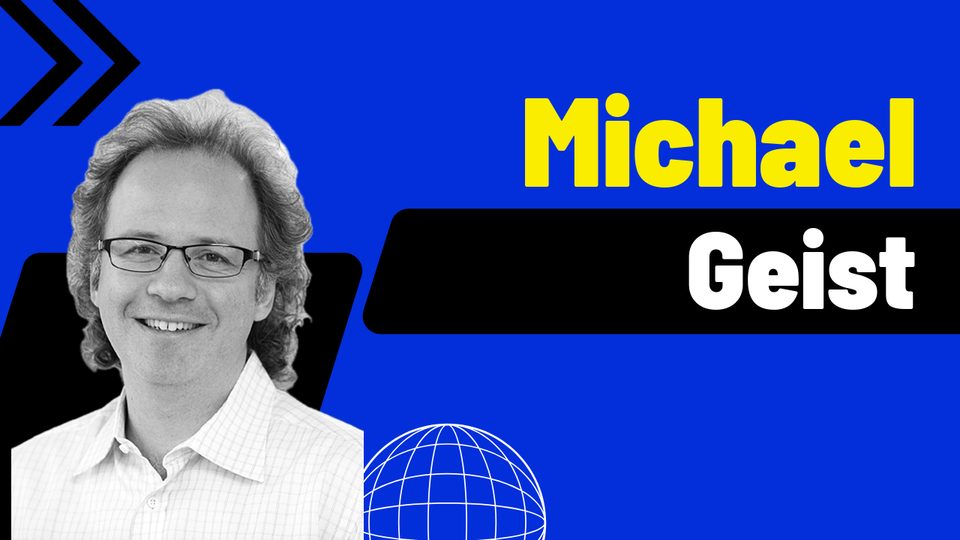
Michael Geist
on intellectual property, digital policy, AI, and law students
The podcast version. It also plays in any podcast app.
Transcript
7,975 words · about 35 min to readMark the passages that stay with you: press the number beside a paragraph. Marks are anonymous, and the most-marked passages help choose what goes into the book.
To hear a passage, press ▸ under its number; it plays just that paragraph.
See a misspelled name or a wrong word? Select it and press Report an error, or email the correction. The transcript is machine-made; corrections are welcome.
Hello everyone, welcome to another great episode of The Yunusov Question. My name is Pulat Yunusov, I'm a litigator lawyer here from Toronto, and my guest today is a law professor at the University of Ottawa, the Canada Research Chair in Internet and E-Commerce Law, and a member of the Centre for Law, Technology, and Society, Professor Michael Geist. Hello, Professor Geist.
Hello. It's nice to see you. Thanks so much for having me on.
It's very nice to see you. You know, I've been following you for 20 years. I think I told you about it, but 20 years ago, I was, you know, I built my first Linux box from off-the-shelf hardware, from off-the-shelf components. And I decided to never use Windows again because Microsoft was anti-open source and anti-freedom, as I thought back in the day. And I really liked Linux because to me Linux embodied free software. That was a word back in the day. I don't know if anyone ever, you know, says that anymore, free software. And I used Linux and I grew with Linux. Linux was awkward first and then it got better. And then I gave up years, a few years later, and I switched to Mac, and I never looked back.
The Mac, of course, is not free software. So back in the day, you embodied this movement. There was a conflict between rights holders, intellectual property owners, and I would say a community of people who used software or used intellectual property. And the conflict was very simple. IP holders wanted to control their property, the intellectual property, as much as possible, and users wanted to have as much access to that intellectual property as possible. So that was the conflict, and it was very much up in the air. Things like DRM were discussed and digital rights management and Napster and Kazaa and things like that. And people were accused of stealing. And there was a true debate between the likes of you and I think Lawrence Lessig also comes to mind as another big name in that arena.
And then I feel like that whole debate subsided and slowly sort of transformed into something completely different and maybe disappeared. So what happened? What is the outcome of that big fight of the early 2000s? What is the scene today? What is the status today between these two groups, users and IP rights owners?
Yeah, no, I mean, you bring me back when you start talking about some of those early days, and it, and it is certainly true that For a long period of time in the early 2000s up until, I guess, roughly when we saw legislation in Canada introduced and ultimately passed in 2012. This was an issue that I think preoccupied certainly individuals that were engaged in this, preoccupied the courts where we had a number of cases. This will be 2024 is the 20th anniversary of the CCH case, which was really the landmark copyright case that had enormous impact for the two decades that would follow. And then, of course, governments sorting through some of those various contests.
You know, I would say, I guess, two things in response. I mean, in certain respects, though, at least in Canada, where much of that debate ended up was with the copyright reform that we saw in 2012. And it was legislation that I think, you know, certainly gave rights holders some of what they were asking for around, you mentioned digital rights management and that, Those provisions largely emulating what we saw in the United States was included. But there were a range of other provisions that were included in the law that I think recognized that the arguments that had been made by users, had been made by the educational community, by librarians, by a whole range, as you suggested, a pretty wide range of different groups coming at this issue.
And so we did see in Canadian law quite a number of very notable provisions that were designed to reinforce that copyright is a balance, that there are both user rights and creator rights, and that very notion of user rights articulated by the court became, I think, exceptionally important. So on the one hand, that particular era, I think, at least in Canada, culminates with court decisions that, as I say, are very strong in terms of technological neutrality and user rights, and from a legislative perspective, provide wins for all sides. Legislation that left people a bit happy and a bit upset at the same time, which probably suggests that you've done a decent enough job trying to strike a balance.
It's interesting that this is where you start, because if I think about where things are at right now, I think we're on the cusp of relitigating, so to speak, not necessarily in the courts, although potentially there, some of these same kinds of questions. And it comes up now, I think, in the context of AI. And we're seeing some of the same sorts of issues arise when it comes to generative AI systems, inclusion in large language models, the outputs that these AI systems develop. And to me, there are many of the same kinds of arguments where, once again, rights holders arguing about limited use of their work, requirements for licenses and the like, and parties on the other side saying, well, hold on a second, this is new wine in old bottles.
It's the same issue that we've been dealing with in terms of ensuring that we can support innovation, that there is, that there are user rights, and user rights may well include some of those abilities to learn even if we're dealing with a machine. And we haven't seen all that stuff sorted out yet. I think we're at the very beginning of that, but it feels as if we're in some ways almost entering a new era where some of those same kinds of questions are rising, but with new technologies.
Intellectual property is an interesting beast in law. It's very different from contracts. It's very different from real property. It's very different from traditional property. It's a creature of statute. It's not part of our common law tradition. It had to be invented by the legislature. And it had to be written from scratch. Yet law around IP is some of the most intense law, if I can put it this way. For example, criminal penalties follow violations of IP rights in some cases. This is really intense. We created criminal consequences for people who download movies online. And it's not even part of our tradition, it's not part of the common law, it had to be invented.
So somebody came, a politician came with the support of maybe some intellectuals or other interested parties and simply wrote this from scratch. So this is very intense. There's criminal liability, and usually we attach criminal liability to behavior when we consider this behavior immoral. Now, you can deliberately breach a contract causing $1 million in damages to the innocent party, and it's not even going to occur to anyone without more to demand criminal consequences for you. You can deliberately breach a contract with a vulnerable party, causing, you know, ruining their life. No one's going to become very intense about it at least not to the level of criminal con— so what is it so special about IP that at some point in the 20th century our society decided that this is probably the most important property that ever existed, such so important, more important than air.
Clean air is less important. I'm sorry, we're still fighting if polluting the air is immoral or not. We're still fighting about it. So it's more important than clean air, more important than clean water, more important than wages. Why at some point in the 20th century some people got together and wrote this from scratch to make this the most important property ever known? In the Western world.
Okay, it's an interesting way to put it. I'm not sure that I'd agree that it's, I definitely don't think it's more important than things like air and clean water and the like. And I'm not sure that the law does either, but I do take the point that this has been an issue that has obviously captured a lot of attention from politicians and have come up with laws that can be viewed, I think, as very stringent in a way that, we might not otherwise anticipate. And I think we can, you know, as I think about it, I think we can point to a few things. I think first, I guess I would suggest that part of the reason of what we've inherited with respect to IP comes from a reality that for the most part, up until fairly recently, up until last several decades, IP was largely a commercial issue.
It was one that, you know, to your point of, you know, commercial contracting and the like, IP was largely in that same bucket, right? I mean, individuals might create. But in terms of the commercial exploitation of works and commercial use of works, we're primarily talking about large, large players. You know, in the music space, it was about how radio stations were using things, and in other spaces, it might be how publishers would use this stuff. So the idea that, that individuals, that millions and millions of individuals would actively interact with intellectual property issues wasn't really seen as particularly relevant. It was either swept aside or just it The laws weren't really drafted with that in mind.
You know, what changes with the internet and new technologies is that, you know, people can code, people can create YouTube shows or podcasts and TikToks and a range of different things. And suddenly you do have millions of people who are both users of copyrighted works, the creators of copyrighted works, and copyright law, intellectual property laws start interacting and engaging directly with individuals in a way that that didn't exist before. So viewed in that light, it shouldn't surprise us that some of these rules may not be fit for purpose, that it's not really what they had in mind. You know, you think, for example, of, you know, in the United States, huge statutory damage liability for individuals for back in the day downloading a few songs.
And, you know, the— those kinds of rules around statutory damages, which themselves are really unusual and rare, you— were premised around large-scale commercial infringement, that this was a designed to create significant penalties for those kinds of instances. I don't think that when those were created, people were really thinking about an individual downloading a couple of songs. But nevertheless, at least in the US, that was the law that was on the books. In Canada, we've made some changes to retain statutory damages but created a specific category for non-commercial infringement to try to address some of those sorts of issues. So, so part of it is that the law, I think, was thinking, was really drafted in a bit of a different world in terms of the role or the interaction that individuals might have with IP.
In terms of how we've seen this elevation of what's taking place, I think we can point to two things, and they're certainly correlated. One, one would be that there is a cultural dimension, of course, to intellectual property, an important one. Sometimes it's the primary way people think about intellectual property, although of course IP extends far, far beyond just cultural norms. But nevertheless, there is a cultural dimension. There's a reason Canadian heritage plays a critical role in developing this policy. And so to the extent to which there are arguments that cultural sovereignty or the future of cultural sectors are at risk if, unless intellectual property steps in, helps explain why the issue might become elevated as a policy priority.
And then quite simply, I think we've seen, and it remains to a certain extent true still today, that some of the larger established players are well organized. They've got politicians' ear on some of these issues. They've got that kind of argument around, you know, what you're doing here is saving or protecting culture. We saw it most recently with legislation like Bill C-11 and C-18 around online streaming and online news. And so, I mean, same kind of arguments keep recurring all the time. And Many of the, many of the people who also have a direct interest in intellectual property, either as consumers or themselves as creators, are frequently far less organized. They, they don't have the same kind of recognition amongst the political set or even amongst policymakers.
And so, you know, from a policy perspective, it's a bit of a closed loop with the same voices urging particular reforms and it'd be very difficult, I think, for those that are, I think, would look at IP or look at copyright as just as important to them as it would be to many others, but don't necessarily have the entry point or haven't been afforded the same kind of recognition by those in positions of decision-making.
I want to return to the primary topic of our conversation, intellectual property. But for now, I want to change pace a little bit and talk about you. Because you represent a big part of, of this topic, you personally, your persona. So let's talk about you a little bit. You are a law prof at University of Ottawa, Faculty of Law, of course. Are you originally from Ottawa though?
No, born and raised in Toronto.
Oh, nice.
And, and been— yeah, I like Toronto. Still Leafs fan. I've been in Ottawa for 25 years now.
So where in Toronto did you grow up?
I grew up in North York. Okay. You know, with a typical kind of suburban life in Toronto and, and like Toronto a lot. And frankly, you know, didn't necessarily anticipate or envision being elsewhere, although I did graduate studies in a number of different places. And once I decided that the academic route was the path that I was most interested in wanting to take, You know, there are a limited number of those kinds of positions. I taught for a year at Dalhousie, but ultimately was able to get a position at Ottawa. And I guess I would say came at a really good time. I joined the faculty in the late 1990s, the very time that some of these issues, the internet and technologies, were really starting to take off.
And Ottawa was a perfect place to do that. And so from my end, from a career perspective, it's been a true blessing. It's been fantastic. And from a family perspective, Ottawa was always this proverbial place to a great place to raise a family, and it turns out that that's true.
Is— was it the perfect place because of its proximity to Parliament and Supreme Court of Canada?
Yeah, you know what you mentioned Larry Lessig there briefly when you were talking about perspectives, and, and Lessig had this, this way of talking about digital policy in particular, and he talked about East Coast code and West Coast code, and his idea was that, you know, East Coast code in the United States was Washington and West Coast code was Silicon Valley. And, you know, part of his thinking and discussion was around, you know, what would— what was most influential in the digital space, that you could write laws, but at the end of the day, software coders could influence the way people acted in ways sometimes well beyond what law could do. And what makes Ottawa particular— certainly what made Ottawa at the time, and I think a certain extent still makes Ottawa really fascinating as a place to be was that it was East Coast code and West Coast code rolled into one.
And so you had both the— you had what at the time people were talking about Silicon Valley North. That's diminished a bit. But yeah, the Nortels and the JDS Uniphases. Now you have Shopify. So certainly there's been a notable tech presence in the National Capital Region. But even more, there was, of course, the East Coast code, so to speak, and the proximity. I mean, the proximity to the court is nice. I mean, you, we have access to judges within the law school, and people have the ability to attend to the court regularly. But it's more, I think, policymakers and politicians, where I appear very regularly before House of Commons and Senate committees. And it's easy to say yes, when you're local, it's, it's easy if someone reaches out and wants to meet and talk about things when you're, when you're in the city.
So there are definitely some advantages, especially if you're focused on things like policy, to be in Ottawa.
You know, you follow the classic academic path. Well, like many in Toronto, you went to Western. This is I would say a local university here in London, Ontario. And then you went to Osgoode for your LLB. I got my law degree from Osgoode as well. And then, and then you did an LLM in Cambridge in the UK, and you got your JSD, which I guess most people don't know what it is, but I guess it's the doctorate in law. From Columbia University in New York. And I— did you become a law prof right after your JSD?
Actually even a little bit before. So so that— I mean, so the path was, as you suggest, I started at Western. I actually didn't graduate from Western. I just— I did 2 years of undergrad and then went to law school. And so graduated from Osgoode. I actually then did a year of grad legal work in Japan at Kobe University, and it was a really interesting experience. And then from there, as you mentioned, went on to Cambridge, did— got my first LLM, came back and articled. And at the very end of my articles— I articled with Goodman's in Toronto— The very end of my articles got— was offered a— I had— was offered a position at Dalhousie for a year.
They had someone leave the faculty fairly late and were looking around, and my name had popped up. And so ended up moving out to Halifax for a year and taught contracts and corporate law for, for that year, but ended up then going out to the New York area. My wife is a family physician, and she was finishing her residency in Toronto, so it was a bit of a commuting thing in Halifax. And New York's one of these great equalizers, so we went out to Columbia, and I a second LLM and got my doctorate from Columbia. And as you suggest, from there ended up at Ottawa and been here for like 25 years or so.
I bet that you crossed paths with another guest of my show in New York when you did your SJD, and I'm talking about Lorne Sossin.
Yeah, of course. Well, we, we actually didn't— we— yeah, of course we didn't actually cross paths in New York. He predated me at Columbia, but we were both—
Oh, you weren't there at the same time? You were not there at the same—
We weren't there. We were at Osgoode at the same time. We were not there at the same time. We both were what's known as an associate in law at Columbia. So we both did, which meant that you were teaching legal research and writing and doing your doctoral work. And so he had been there just before me, and I remember reaching out to him specifically before I went as part of this associateship in law program, but we were at Osgoode at the same time. So yeah, I've known Lorne for a very long time.
Yeah, I just realized you both were the '92 class of Osgoode.
Yeah.
Oh, okay. So you must know him really well. Of course, Lorne Sossin is a Justice of the Court of Appeal for Ontario, one of the guests of the show. You followed, like I said, a classic academic path, very similar to Lorne Sossin's. Have you ever considered becoming a judge? Another way to influence policy, by the way, and the law.
Yeah, no, of course it is. Honestly, not really. I mean, yes, have I thought about it as I see people that I've known and worked with and the like get called to the bench to become judges? Well, of course, but generally no. I mean, honestly, I think I'm just having too much fun still as a law professor. I had a colleague very early in my career as the prof at Dalhousie, actually, you say, you know, best career in the world. You get to do you get to teach a bit, you get to write, you get to pursue what you're most interested in, you get to pursue other kinds of activities in and around the law.
You can really, you have the, you kind of, what I feel is a really privileged position to be able to actively engage on, on a wide range of issues. Nobody tells me what to say. I get to say what, what I think and, and how to allocate my time, by and large, you know, beyond sort of obviously the teaching administrative type obligations. So I've I've been super fortunate, and I must admit, I, I'm, I remain pretty happy in this career.
You have taught many, many generations of law students over the years, probably about 10 generations of law students, if I'm not mistaken.
I'm not sure how you're calculating that, and you're making me feel very old as you keep adding the very—
No, no, no, I mean like classes, not, not human generations, but classes law school classes.
Yeah,
probably about 10, something like that. So you have this long view of how law students changed over the last couple of decades. Can you talk about that?
Yeah, well, there— yeah, I, I guess I would say that there's the way that law schools changed and the way that law students have changed. And from a law school perspective, I remember when I first arrived, we didn't have there weren't electrical outlets in the classrooms, and we— I don't think we even had the so-called multimedia setup. And, and then eventually we got one classroom that had it, and I remember there were even professors that were uncomfortable with computers in the classroom. In fact, when I was an associate in law at Columbia, the way that it worked was that you, you taught legal research and writing for the first half of the year, then you did your research and graduate work in the second half of the year, and you were also assigned to a professor who was doing introductory stuff for first year JD students at Columbia.
And I remember the, the prof that I was assigned, he actually asked all his— all the students who used laptops to be confined to a particular corner of the room because he found it disruptive to hear the keys clicking and stuff. And of course, all of that has changed. I mean, nowadays everybody comes with laptops and there's connectivity and there's multimedia and stuff like that. And it, it, it provides opportunities in terms of how you can use the technology. To bring people into the classroom. I just finished teaching an intensive course in January where I had some guest lecturers coming to class. I had a number of others who participated via Zoom.
And, you know, people can give you the hour, but they can't necessarily give you much more than that. And so it was great and it really enhanced, I think, the experience for the students in the classroom. So I think the, the law school environment's changed a lot. As for the students, You know, I think they've gotten— well, I keep getting older and they seem to stay roughly the same age, but I, I, I would say that, you know, one of the things that I think that we do see is that they come now with more experience than certainly was the case early on. And I think that reflects that this has become— even as we have more law schools, it still becomes an increasingly competitive place to be.
And so you get more and more students that come with graduate degrees, and particularly given that we, we've got a very strong technology law program at the University of Ottawa, I think the strongest in the country, we get quite a lot of people coming out of the sciences and engineering who sort of, who want to be able to continue to pursue some of those interests but be able to do it in a legal context. And so they, they sometimes choose Ottawa. So, so the background of the students as well in terms of their previous studies has evolved a bit, at least in terms of some of the kinds of students that we are able to attract.
When we talked about the tension between users of IP and owners of IP, and when we talked about the evolution of that tension and evolution of the law and how the law sort of settled down a bit over the couple of decades, you said that new issues are now arising. You said that this is now about to be relitigated or re-legislated, maybe. Can you talk about that a little bit? You mentioned AI. What do you have in mind? What are these new issues that perhaps are stirring the same similar winds to 20 years ago?
Yeah, so I mean, and so a good example is in fact generative AI, where, you know, when we think of generative AI, for those that don't follow, are probably maybe more familiar with ChatGPT, which of course has taken the world by storm over the last year or so. And the Copyright-related questions involve a number of different issues, but especially around questions about how you teach these generative AI systems, teach so to speak, in terms of the information that is fed into the system that then is able to produce either the text through ChatGPT or the images that might be produced through a DALL·E or a Midjourney AI or some of the other sorts of services that are out there.
And so the questions of You know, do you need a license to do that? Is that fair use or fair dealing to use it? Is this roughly the same as the scraping that, or indexing that took place by search engines to identify that content? And they're not republishing the same content, they're simply using it to identify where it's located and send people on their way. In this instance, they're using the same materials to engage essentially in statistical analysis and probability to to begin to produce the kinds of things that a generative AI system produces. So is inclusion within the large language models that are used to so-called teach these systems, how does copyright interact or intersect with that?
And that's sort of the input side. And then there's the output side. And so when you think about the text that a ChatGPT might generate or the images that it might generate, and at times it may look very similar to some preexisting text, is that infringing? You take a look under the hood to see the tech, how the technology itself functions. And for the most part, it seems that it's likely not. But nevertheless, we've seen now a lot of cases. So there's quite a large number, especially in the United States, but also in the UK, of class action lawsuits, some really prominent ones that are, that are essentially suing some of the largest AI providers at times for the inclusion of their materials and at times for the outputs themselves.
And so we're at an early stage in that regard as these cases make their way through the courts. So far, many of them have been dismissed on different grounds, but some of the core questions are still yet to be determined, and I think it's going to take a bit of time for that to sort out. And in the meantime, we are seeing, consistent with what we were talking about a little bit earlier, the pressure on governments to do something. And so far, that, at least in Canada, that do something has largely been to consult, to get a feel for where people are at on some of these issues. So Canada just concluded at the deadline for a consultation on generative AI and copyright.
We'll see what the outputs are in terms of the outputs of that consultation. But it does seem to me that at this stage, the, you know, it's clear the government sees that there's an issue. They're pursuing AI regulation in other places. They're considering some of the copyright implications around generative AI. And so it feels a bit like the early days of you know, not necessarily peer-to-peer file sharing, but the early days of that kind of digitization and, and the emergence of the internet, where you could see that there were going to be implications for copyright. And some of the kinds of things people were doing felt copyright already permitted and perfectly fine. Others said it's not fit for purpose and we need to see changes.
And so you can see the kind of the storm clouds ahead, so to speak, in terms of some of the same kind of battles, I think, lying ahead over what's the appropriate place for copyright law within this generative AI world.
You know, the concept of copying is really central to copyright law, as the word copyright suggests. And I wonder if copyright law really should be about distribution rather than copying. And I wonder if we should upgrade the concept of copying in our law. So, for For example, when I open a New York Times article, like let's say I have a subscription, I open a New York Times article, my eyes transmit a copy of the article into my brain. So I'm making a biological copy of the article using the neurons and the electric signals in my brain. If something very similar happens with, with AI when a machine makes a copy technically to take further action, to process the article, to, like you said, to make a statistical analysis, to train artificial intelligence to learn, and so on and so forth.
Technically, that's a copyright violation unless the license from the rights holder permits this specific you know, use unless the license permits the machine to take a peek, right? So we're talking about taking a peek here. But what I think rights holders have a big problem with is really distribution where after taking a peek, you retain the copy and then you share the copy with others. So should we upgrade the concept of copying? Is copyright really about copying or is it about making money off of somebody's content?
Yeah, well, so a lot of, a lot of points that you've just made that I think are notable. I would start by saying that I think, you know, you also mentioned earlier on digital rights management and the anti-circumvention rules that were hotly debated late '90s, early 2000s, and ultimately became part of the law in 2012. And I have to say that that actually is a pretty good illustration of copyright law going beyond just pure copying. The idea behind anti-circumvention rules was actually not about people making copies of works or even distributing works. It was about, by and large, access to works and trying to protect the technology that itself was protecting the work. It was essentially saying we could use technology to lock down materials, but people will find ways to circumvent or get around those technologies.
So you need new laws that make the act of circumventing itself an act of infringement, or even permitting distributing the tools that could be used, i.e., the software that could be used to circumvent, making that an act of infringement. So it feels a little bit like the notion of limiting copyright to copying, you know, that train's left the station quite a while ago. We started to see a lot of other issues, I think, emerge in terms of a much more expansive view of copyright. I would say that, of course, the distribution side or making available is you know, is seen as an important issue by many rights holders. So they sort of do see the link there to commercialization.
But I don't think that it's the only one. I mean, I certainly think we take a look at some of the adaptations that take place, the fan fiction and the like, and at times that's just a battle of creators saying, you know, do you own— it's not even the distribution side. Do you own the right to these ideas or the manifestation of these ideas in a way that you can prevent someone else from engaging in some of that same kind of activity? And And of course, we have seen— I mean, it's a simple reality— we have seen cases, especially around the file sharing side, where the focus is not on the person doing the distributing, it's on the person that's accessing and saying that that mere access is itself infringement as well.
So, you know, downloading without authorization may lead you to receive a demand letter from someone via the notice and notice system saying, hey, you need to pay up. And so We've seen a lot of that. We've seen in Canada still, still today. So I think, you know, I think one of the things that we've seen over the last number of decades really is this massive expansion, not just in terms of copyright, in terms of who it applies to. We talked about that earlier, moving from sort of the commercial space to now having an impact more broadly. But I think it's fair to say that the, that very notion of copyright has expanded significantly. To include not just that pure notion of copyright or the reproduction, but something far more than that.
And that it would include making available distribution. It would include protection of the technology itself and those kinds of things with what is sometimes referred to as paracopyright. And frankly, if you take a look at even some of the legislation we've seen around, let's say, like C-18 in the news, that very notion of linking to content. And now we're not even talking about this. We're not talking— I have a hard time explaining what it is we're talking about from a copyright law perspective there. But certainly some of the discussion around C-18, this was the online news bill that sought to bring in Facebook and Google to force them to pay news outlets for linking to content.
Well, I mean, this notion that there's a right associated with linking to content that maybe an IP right or a quasi-IP right or some sort of right. There's got to be some right there if this is the case, you know, has become part of the discourse. And so it points to a much, much more expansive vision that some have for what copyright is or should be doing.
You know, I have to tell you a story in connection with claiming rights over linking. I think you might be interested in it. Before the pandemic, the Law Society of Ontario had the linking prohibition in its terms of service on its website. There was a provision in the terms of service that said you had to get Law Society's consent to link to any page of our website other than the homepage. And of course, then the pandemic hit and Law Society started posting a lot of crucial materials for lawyers to operate during the pandemic. And I tweeted I said, well, we can't share these materials on Twitter because then we will be technically violating the linking prohibition, the terms of service.
And this is the pandemic, that's a crisis right now. We have to share these materials. So to Law Society's credit, the treasurer immediately responded and they removed the linking prohibition from their terms of service almost immediately after my tweet. Just an example, I guess I contributed a little bit to the fight that you've been fighting in all your career. But I also wanted to ask you about AI and generative AI. So as a teacher, I'm not suggesting that that's what you do, but as a teacher, you probably know that, or maybe you disagree, that teaching is largely regurgitating copyrighted material. You read copyrighted material and you regurgitate it to students. I mean, you, you add value, of course.
I'm not denying the value of teachers, but in the grand scheme of things, you, you read copyrighted material, you read IP. So you create a biological copy of IP in your brain. You process it, you add your, your value, you, you create some, generate some ideas, you draw some conclusions. And then you regurgitate that intellectual property to your students with your thoughts, comments, and ideas. I think that's largely true about any teaching. Isn't this the exact same thing that generative AI does? So how is that an IP issue then?
Okay, so I'll agree in a minute. I'll agree obviously that there's an But of course, copyrighted materials, sometimes our own copyright, sometimes public domain, but copyrighted materials otherwise, knowledge products are certainly, form the basis for a starting point of a lecture or a class. I mean, I think, or at least I hope that they go beyond that, that in fact the real value is not in any sort of regurgitation, so to speak, but rather in the engagement and the discussions and the thinking that takes place where, you know, law schools aren't— of course aren't trade schools. I mean, they're, they're not in the business of preparing people per se for like bar exams and stuff like that.
Of course there are classes that may help you with the bar exam, but it's less about the, the full transmission of knowledge and more about giving people some of the skills and tools that, that they, that they need to be able to practice and You know, there may be lawyers that say that the students arrive without enough of those kinds of skills, and then we leave it to the profession to do the training they actually need to practice. But that's an issue for another day. You know, there are, of course, similarities. And listen, I think that there are compelling arguments that on what generative AI is doing, which is, as I alluded to a bit earlier, really more around statistical analysis.
It's not interested in redistributing the actual text. It's, it's not indexing it in the way that you would index in even in search, which actually is one reason why I'm not wholly convinced that the approach we've seen in search to that has essentially permitted the ability to index this content can be applied in precisely the same way when it comes to generative AI and large language models. But regardless, I think there is a strong argument that this, that there are real clear similarities between the two. The issue that I think we will face, and I don't know what the outcome will be either from a sort of political perspective or from within the courts, is one much like Napster, actually.
You know, you started a bit with the peer-to-peer file sharing. So, you know, if I think back to some of the arguments in those days, you had people who said, listen, no, you don't really understand what's happening here from a pure technical perspective. These peer-to-peer environments, no one's actually sharing, no one's sending you a file. It's little bits of information that are all being distributed, and then they're being all brought, they all land on your desktop, and you put them all together, all the pieces of the puzzle, so to speak. And it turns out you can put Humpty Dumpty back together again, and before you know it, you've got a Taylor Swift song. So the idea is that they're saying, you know, you don't get that this is not copyright infringement in the way that you think of it.
This is just the movement of small pieces, each individual piece that's taking place is actually not the underlying work. And for the most part, courts looked at this and said, nah, if this looks like infringement and feels like infringement and results in what to us feels like infringement or unauthorized activity, then it's going to be infringement. And I do wonder the extent to which we will head down a similar path when it comes to AI. Around some of the generative AI where certainly those from the technical community will make, I think, very strong arguments to say, here's what's actually taking place. So here's why what is happening is no different than an individual just consuming large amounts of content and, you know, not, and then using that content to be able to produce new kinds of content on that basis.
And this is just technology that's now enabled this in a way that wasn't allowed before. And I think that we may end up with some judges who will take a look at this and will say, no, this looks to us like infringement. And so we're not comfortable with the approach that you're taking. So it does seem to me that, you know, there's the— what's happening sort of under the hood, there's the technological reality of this. And then there's the sort of the political policy reality. And, you know, when judges encounter this, when politicians encounter this I get like our experience suggests they're not always persuaded by a pure technological explanation for what's happening.
Yes, it's often about simply allocating the cost or allocating the risk in a way that the judiciary thinks is best for the public interest. For it makes me think, you know, of the case when there was a concert that was recently before the Court of Appeal. There was a concert at Ontario Place here in Toronto, and some guy was drunk leaving that concert wearing flip-flops. The bridge across Lakeshore was closed by security, so he jumped down the hill and hurt his knee. And the court found that it was Ontario Place's fault, right? So people might think, well, how, how come? But, you know, if you think I think in terms of large social interests, public interests, maybe it makes sense because you got to point a finger at someone who is in the best position to make this issue go away in the long term, right?
So the last topic that I wanted to cover with you is code is law. And, you know, it's viewed with contempt by many in the legal industry, by many lawyers, by many law profs. This whole theory that code is law, it is commonly associated with cryptocurrency. But when you spoke about DRM, I couldn't help thinking that DRM was an application of the same idea, where the other side now tried to use technology to achieve what law couldn't achieve. To supersede law, to say, try me, you know, maybe you have the right to copy this work, maybe you don't. I don't know, we haven't litigated it yet, but you know what, I'm just going to use DRM and I'm going to close this issue because you're not going to copy because of code, not because of law.
So essentially, IP owners said code is law way before crypto users.
Yeah.
What do you think about this whole, this whole theory, this whole doctrine, code is law?
Well, so I, I, you mentioned Lessig as being one of the originators of that, and now we see much more of the discussion. I agree with you on smart contracting and Ethereum and many of the other sorts of crypto activities, you know, which, so, you know, some of which just feels like casino and a lot of you know, sort of proverbial get-rich-quick schemes. But at the same time, I think there's some real— I think there's some really interesting kernels underlying some of the activities that are taking place, some of which are, you know, come from some of the same kind of ethos that you were talking about earlier around openness. And you see that in terms of shared resources and stuff like that, that we do see coming up out of those— some of those communities.
So I would say that that, you know, what, that it remains the case that absolutely there is a, that code can regulate effectively what people are able to do. What may have been underappreciated or underestimated decades ago is that the extent to which we can regulate the code. And so code can regulate, but at the same time, there's that, there's ability, or at least going to be desire, to regulate code or those that create the code. Depending on the circumstance. And so I think we've seen over the years, and it can involve, you know, attempts to regulate in, let's say, in the, in certainly in cryptocurrency area, but even more broadly, if I think about a number of the different areas, in AI would be another example, and even the internet and large platforms, which previously lived in, in a world where some argued that they were ungovernable and they couldn't be regulated, not as a matter of code, but simply that it was technology and that, you know, that the algorithms were doing what they were doing and that there was just no role for law.
And I think that that's— that by and large represents an era that has passed. I think that there is a danger of the pendulum swinging too far in the other direction where we see regulators seeking to regulate in places where frankly they're really just representing you know, those that have struggled to adapt in the current environment as opposed to representing, I think, public interest policies. But nevertheless, we are at a place where there is a greater comfort level with certainly politicians engaging with these technologies and, and saying that there needs to be rules of the road, there needs to be guardrails around some of these issues. And, you know, we're grappling with them on everything from privacy and competition and data.
All these issues are all the kinds of things that are at play right now.
Professor Geist, I've wanted to talk to you for 20 years and you made my dream come true today. Thank you so much. I really appreciated this conversation.
That's so kind to say. You should have reached out before, but I'm glad we met. I'm glad that we connected now. Thanks so much for having me.