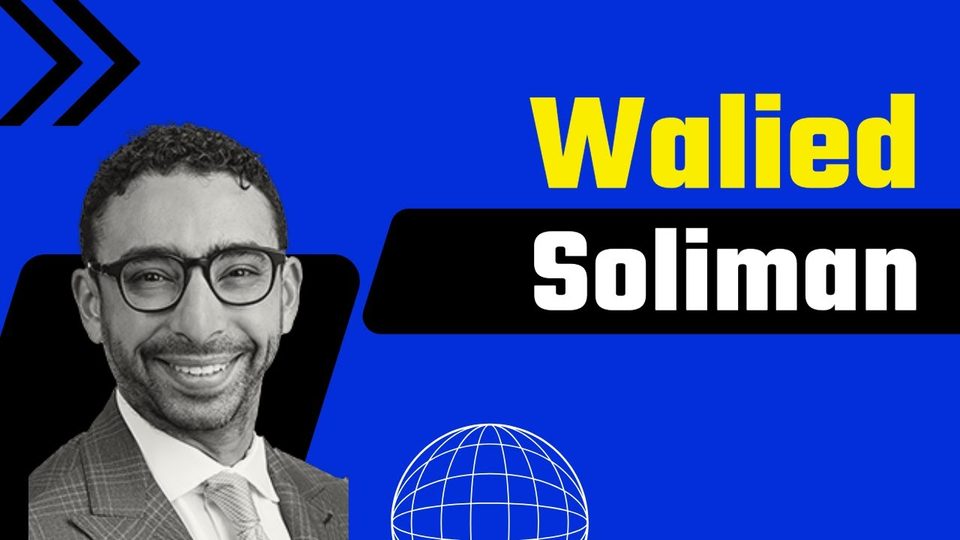
Walied Soliman
on global law firms, corporate lawyers, special situations, and the Middle East
The podcast version. It also plays in any podcast app.
Transcript
6,401 words · about 28 min to readRecorded 24 September 2024. Machine transcript; names checked by AI against the episode notes.
Mark the passages that stay with you: press the number beside a paragraph. Marks are anonymous, and the most-marked passages help choose what goes into the book.
To hear a passage, press ▸ under its number; it plays just that paragraph.
See a misspelled name or a wrong word? Select it and press Report an error, or email the correction. The transcript is machine-made; corrections are welcome.
Hello everyone. Welcome to another episode of The Yunusov Question. I am Pulat Yunusov, the host of The Yunusov Question, commercial litigator here in Toronto. I always have wonderful guests, I always have amazing guests. Today's guest is very special guest. His name is Walied Soliman, global chair Norton Rose, Fulbright Canada, LLP. Hello Walied.
How you doing? Pulat. So nice to meet you. Thank you.
I'm doing very well. It's very nice to meet you. Did I say your title correctly? Correct?
Yeah, that's what they call me these days. We'll see what they call me next week.
I've always been curious about global law firms. Maybe we can just jump straight into the meat of the conversation. I've always been curious about global law firms. I mean, we know how law firms are organized in Canada. They're usually partnerships, usually limited liability partnerships. There is a limited liability partnership act in Ontario. Tell me more about the structure of global law firms. I mean there is no global limited liability Partnership act. There are no global laws anyway according to many observers. So how does this work?
So there's a spectrum on how global law firms are structured. There are firms that are truly separate partnerships in different jurisdictions, but that are one economic pool and that are truly one law firm, one partnership. They calculate their profitability as one partnership and you go all the way to the other spectrum where you have things sort of like Lex Mundi and these sorts of things, which are really just associations of law firms. Somewhere in the middle is I think the ideal structure for a global law firm and it's really like most things lawyers do, we follow precedent. And so the KPMG, Deloitte, PWC, Ernst and Young, they are all structured as what was called a global Swiss Verein and Swiss Verein structures are essentially a partnership of partnerships and that's what we are. We are a partnership of partnerships, five regions, Canada, the United States, Europe, middle East and North Africa as one region, South Africa as another region, and then Australia as another region.
And each of those are a separate economic partnership and then there is shared costs in the middle and then there are referral fees that go back and forth. In addition to that, there is obviously the same branding and there is the same billing structure and obviously strong incentives for people to send work back and forth with regions. The reason this structure works really well for accounting firms and that we've copied it and it works so well for Baker, McKenzie, Norton, rose, and the other sort of top global firms, is that it allows the individuality of different countries, the different profitability structures of different countries. South Africa is a very different profitability model than Canada or the United States or the United Kingdom. So it allows that independence, that pride, that dignity. It doesn't dilute certain the economics of the partnerships and it allows for individuality while ensuring that things sort of come together quite well in the middle.
You know how I can tell that you're a good lawyer, you answer my questions before I even ask them.
That's great.
On the topic of good lawyers, on the topic of good lawyers, this show The Yunusov Question, it has a litigation slant. I admit it. Vast majority of my guests are litigators. I interviewed more than a dozen judges of all level Supreme Court of Canada all the way to the Superior court of Ontario and I admit that it has a litigation sl. So I think this show has done a good job of showing what a star litigation lawyer is.
You guys have actually done a great job
Of it. Yes, thanks. I want people to remember that litigation lawyers are not the only lawyers out there. Litigation lawyers are a lot like Americans, it's Americans and everybody else. So I want our audience to remember that litigation lawyers are not the only ones. So can you talk to me a little bit about what is a star non-litigation lawyer, for lack of a better word?
So first off, I'm going to agree and disagree with you. I'm going to agree with you that the world is full of a lot more than litigation lawyers. I'm going to tell you though that if you want to meet a star corporate lawyer, there's many that are actual stars out there. I'm a guy who aspires to that. I always tell my partners, you've never watched a movie, you've never seen a sitcom where a guy sits at the head of the table at a dinner and introduces his lawyer and he says, this woman is the second to best lawyer in Canada. Never. The reputation has to be that you are the very best at what you do and that is what we strive for with our clients. That's what we strive for with our colleagues and what is the best, it's number one, having the best character that you can have in otherwise adversarial situations. And that's very hard and I think that that's something that comes with time and maturity and I think we all try to yearn to get better at that. I think the second thing is being be able to get results for your clients and get those results by being creative, being thoughtful, thinking outside the box, trying to find solutions to otherwise very difficult problems. And I think that's what makes a great corporate lawyer.
You've hit a few basis in your answer that I really want to return to each one of them. Let's start with adversarial situations. Litigators came to think of their practice as predominantly adversarial. Our justice system is by definition adversarial justice system. What is the share of adversity in your work or maybe non-litigation lawyers' work in a big firm in a business context? How adversarial is it really? Are negotiations adversarial? Are contracts adversarial? Is compliance advice adversarial? Can you please talk to me about that?
Look for those who know me, I spend about 15 20% of my time as the chair of the firm. I view it as a governance and oversight role. I spend 80, 85% of my time in my practice and the practice that I have, I co-chair our firm's special situations team and the special situations team's focus is on shareholder disputes where there's a shareholder trying to take out a board. We defend boards where for 18 quarters now had the leading practice in Canada, in the area of boardroom defense, we sometimes act for activists trying to take out boards. We defend boards against hostile bids, we act for hostile bidders and Pulat, in each of those areas it's necessarily adversarial and in fact zero sum. And it is easy as a lawyer to get caught up in the zero sum and in the emotion of the zero sum.
And keep in mind in my world, there isn't a judge. I don't even have to be nice in front of anybody. I am just dealing with somebody right opposite me. And you learn very quickly that the best way to get results for your clients is number one, to maintain the best character that you can maintain. And number two, to very creatively and thoughtfully and intentionally reflect on your opposition's interests and how it is that you can get to a landing. In fact, I'll tell you this ette. When I'm defending a board and the situation turns into a public fight, one of the first questions I ask myself is whether I have somehow failed to read the room of my adversary, whether it is the lawyer or the client, and whether I have not understood my own position adequately before allowing a situation to get to a fight that's on the front cover of the business sections of the newspaper. So very adversarial, but practice easy to get caught up in your emotions. I admit that I certainly do from time to time and I often reflect on how I can do better in that area.
I really like the metaphor that you offered us failing to read the room and the critical nature, critical importance of reading the room in any adversarial situation, in any dispute. I really like this metaphor. I want everyone to take this away from today's interview because this really is a big part of litigation is reading opposing counsel first.
Absolutely.
And then eventually reading the judge. Hopefully it doesn't get to that for many civil litigators, but it sometimes does. I'm curious about the special situations as well. I was curious about it when I first heard about you because your name goes right next to the phrase special situations. I find that your name is almost a synonym for special situations in Canada. I don't know how you did it, but I want to say that, so to me what you describe as a special situation taking out a board is a litigation issue. I take out boards in some of my cases, I take out boards. I'm a board assassin, metaphorically speaking, right? But I do it using litigation tools. I do it using the oppression remedy for example. I do it using other remedies offered by the Business Corporations Act here in Ontario or in Canada. Correct me if I'm wrong, but you're not a litigation lawyer.
No, I'm not a litigation lawyer, but I'll tell you co-chair, the co-chair of the group that I run here at the firm is a phenomenal litigator named Orestes Pasparakis. And you know Orestes and I started this group about 15 years ago, and I can tell you 15 years ago when a guy named Orestes and Walied, guys named Orestes and Walied walked into the boardroom. First of all, most of the boardrooms didn't even know how to pronounce our names. People ask us who the hell we were all the time. And now you're right. We have, I think it was 17 or 18 quarters been the leading defense firm in the country, which is just a humbling, humbling, humbling great honor. But I'll tell you a funny story, Pulat.
When Orestes and I started the group, I was a junior partner and we just decided one day we were going to start something called the Special situations Group. Number one, a lot of firms on the street laughed at us. By the way, there isn't a prominent firm in this country today that does not have a special situations group, but they laughed at us at the beginning and I remember it and I remember it distinctly. The second thing was we just changed our signature lines at special situations group. Fast forward to sometime during the pandemic and I had been the chair of the firm for a few years and I get a panicked call from one of our marketing people and the person gets on the phone and says, we're redoing our website. We thought we downloaded all the sections, but we can't find the special situations page anywhere and we are horrified. And I just said, well, we're going to have to recreate it. And I immediately got on the phone with Orestes and I said, we pulled a scam for 15 years. I can't believe that they've just discovered that we established a group at the firm and that we never got approval from anybody.
And now there's a very prominent special situations page and this will be the first time that that person in the marketing group knows that it didn't. In fact, she never lost it.
What is your playbook? What is the special situation's playbook? How do you defend boards without resorting to litigation? How do non litigators do disputes?
So first off, I remind my team all the time, we get very bad problems by the time they come to us. We get shareholders who are on their last legs trying to take over a board and don't have enough shares to do it. We get boards that really believe in a thesis that they're advancing but have not been able to convince their shareholders and have a shareholder revolt in front of 'em. So I think the first thing that we try to very carefully do is assess the situation, assess it very, very, very carefully. I always tell boards you have to have a thesis and a or else you're a rudderless ship and if you're a rudderless ship you're going to crash and you're going tore going to have problems. So we really try to assess the situation. We try to assess is this a board and a company that has a plan that is not being understood or is this a board and a company that doesn't have a plan is just entrenching themselves and there's different strategies for each. Canada ette is the most shareholder, activist, friendly jurisdiction in the western world. And so we remind boards that we are in a jurisdiction that in fact favors shareholders to take over a board and it makes it easy for shareholders to take over a board. And so we have to be very, very intentional and very, very, very, very careful.
We end up using actually quite a bit of litigation for that and my partner Orestes and I work hand in hand together, but the litigation very rarely gets you the result. The litigation helps you get some leverage to get your result in our area because ultimately my parents are from Egypt that remind folks we don't live in an Egyptian dictatorship. And so at the end of the day I can do a lot of things to delay, to push back, to create leverage, to make people second guess, to give time for the shareholders to think about things. But ultimately there will be a vote no matter what. Ultimately there will be a vote. And that's one thing I can't solve. You have to count the votes and you have to count them barely.
So special situations still require democratic methods for ultimate resolution. Is that a fair way to say?
No question? At the end of the day, the votes will be counted and all the legal maneuvers in the world are not going to change the vote. If you ultimately haven't been able to convince the shareholders of the thesis that you're advancing,
Is your job ultimately political because it reminds a lot of job of someone who advises politicians on how to garner Marshall votes.
There is a significant, there's significant politics to the advice for sure. There's a significant amount psychology thinking carefully about the right timing and the right place to give advice on these matters. Much like you're right, a political candidate or otherwise. And one of the things that I very often reflect on is how we provide our advice and how successful we are in relaying to our clients the position that they're in. When we get hired by boards, they're not hiring us because we are the nice guys who get settlements. They're hiring us because we have a reputation for being very tough and understanding this space better than our adversaries in the area and shifting the dialogue to look at, I think you're not doing well and there isn't much I can do for you and here's how I think we should bring this to the finish line is not always easy and it's something that certainly I aim to improve on regularly.
What are some of the common situations in which shareholder activism arises? I mean it doesn't happen out of the blue, it just doesn't happen because a group of shareholders wake up in a bad mood and try to replace the boy.
Sometimes it does believe it or not, sometimes it does. It could be a lack of performance. It could be an unpopular CEO, it could be an opportunity that shareholders are seeing that the board is not seeing. It could be a short-term return proposition versus a long-term return proposition. It could be an unpopular group of board members. The reasons are vast.
Who is your client when you defend the board? I always think of the law society's client identification requirements.
That's a very good question. I'm going to tell you we are quite intentional on who it is that we are representing in these fights. I always, always, always think of the corporation first. It's just that has to overlay. That has to overlay your thinking. But that does not mean that a shareholder or group of shareholders, therefore even if they are presenting you with a, Hey, we're at 40% of the shares and we need this change, my duty is to the group that is running the company who as long as I'm satisfied, are using their best judgment to advance the company even though sometimes they may disagree with a large group, even a majority of the shareholders. And that is who my client is.
I see. And you trust the board's judgment of course, because as long as they are the board, this is their role.
A hundred percent. And I'm going to tell you, most boards in this country are wonderful human beings who are really trying their very best. We have good board cultures in this country and I think those boards need to be supported. In fact, recently I've been giving a series of interviews where I've been really focusing on courageous boards and the importance in Canada of having boards of courage that will support their management teams in tough quarters that will support their management teams when shareholders are trying to cause them difficulty. So long as those courageous boards have a firm understood thesis and are pragmatic when someone comes along with a better idea.
Well, from what you have just said and knowing that you've done it for years, I assume there is a board defense bar in Canada or maybe in the world. Is there a shareholder activism bar and I'm talking about by analogy to insurance defense and personal injury dichotomy, for example?
Yeah, listen, we do both actually. We both defend and we act for the other side, Canice two smaller market. You'll find in the United States that there's a lot more definition around this. There is a group of lawyers who are focused on activist defense and there's a group of lawyers who are focused on acting for activists. Really, we act for either our firm and our practice has lent itself to a lot more defense mandates than activist mandates. But we're happy to do both.
You are global chair. You told me that your duties as global chair take significant percentage of your time. Can you tell me more about your role as global chair of Norton Rose? What exactly that you do travel the world, talk to all the different members of Norton Rose, what's going on?
Actually, it was the opposite. It doesn't take a significant, I spend about 15 to 20% of my time on my Canadian chair and global chair roles. Look, I think there was a time in law firms, particularly in Canada where number one, the chair was somebody who was closer to retirement. And number two, it was a full-time job. There's no tolerance for that at any Canadian firm I'm aware of. To have a person make a lot of money to be a cheerleader, I think that's complete nonsense and we've certainly moved away from that model. Our model right now is that the chair role is a governance and oversight role. And I enjoy some cheerleading, right? That's how I define the role governance oversight and some cheerleading, bringing some enthusiasm to the firm. So I'll tell you in Canada, seven years ago, Pulat, I got elected as chair.
I was 39 years old and we set out a mission for the firm and the mission was to be the leading business law firm in Canada and the employer of choice in each of our markets. So two parts to that vision. Number one was to be recognized as the leading business law firm in the country. And the second was having a great culture. And that was driving a culture where we are a great place to work, where partners want to be here, where associates want to be here, where students are fighting to join us. And we did not focus on being the most profitable. We focused on being the best. And I'm going to tell you, seven years in, we just saw some stats from AM law 100, we're seeing the Bloomberg tables, other tables that are coming out. I can't tell you how thrilled I am about Norton Rose in Canada.
We're doing extremely well in each of our principle markets. One of the most profitable firms in the country right now. The culture is very, very, very strong. The league tables are strong. So that is sort of what I enjoy doing is I enjoy providing inputs on that strategy. I enjoy providing the oversight and governance that is necessary. I enjoy telling our story. I enjoy meeting particularly with young partners and helping them get their practices up and running and telling them about my own story and what has worked for me and what has failed for me, what mistakes I've made. Of course, like anybody, I've made lots of mistakes and it's been very rewarding, very, very, very, very rewarding to watch the firm be where it is right now and to know that I've played a small part in it. It's very, very exciting.
Well, let's talk about your story. You mentioned that's part of your role to talk about your story, so I'm going to take advantage of that. You spoke of your parents. One of the questions I ask on the show often is about parents. I think it's so important. Parents are important to where my guests are today, how parents raised them. Tell me more about your parents. Tell me more how they raised you or tell me if you became what you are because of them or contrary to what they wanted. Let's hear that out.
Wow, man, I got to tell you, I'm the luckiest son in the world. I'm sure I know a lot of sons feel that way, but I really feel that way. I'll tell you, my father came to Canada from Egypt in 1975. He worked a bunch of odd jobs. He worked as a security guard at the beginning in Canada and he worked his way until he got his PhD in nuclear engineering in his early forties. And I'm going to tell you, he's a remarkable man. And I actually didn't know him in my early years and into my teenage years because he worked during the day and he studied in the evening and he built a remarkable reputation as a nuclear engineer. He worked for AECL for almost 25 years before he retired. And my mother came to Canada a year after my father. She came in 1976. They met at basically chiro hydro. My mother in the late 1960s, early 1970s in a middle class Egyptian family became an electrical engineer and a successful one in Egypt. She came to Canada. She never worked as an engineer in Canada. She did odd jobs at the beginning when she came here, including even being a seamstress for a while.
And she never worked after I was born. And I have four younger brothers. They're all remarkable people. Two of them are doctors. We have another lawyer and another very successful young businessman. And it's all from the upbringing of those two remarkable people. And I'll tell you something, ette that my dad, my dad, we had, we had a very good upbringing and we were comfortable. But when you get into the circles we're in, you meet a lot of a hundred millionaires and billionaires, really, really wealthy people. My father has accumulated a reasonable amount of wealth by Canadian standards and has a pension from his time at AECL lives in Mississauga. And you've never met a man who at his wealth area, believes in his mind and his heart. He's one of the richest people in the world, not just Canada. And I have billionaire friends who would feel poorer than my father. And he's a remarkable, he's a remarkable, remarkable man. My mother's a remarkable woman. They've done such an incredible job. They've got 18 grandchildren now and they continue to be a remarkable example for us.
Incredible story. You are a master of storytelling. I'll give you that. And usually maybe
I should have been a litigator,
I dunno, a litigator look, you obviously have a litigator gene because you are in disputes. You defend someone, you attack someone, you tell stories, and yet you're not a litigator. But obviously you are good at what you do. So I truly enjoyed your account, your story. Thank you so much for telling this story about your parents. It's really heartwarming. I think we need to tell more stories about parents and parenthood and the importance of parents and parenthood to our success. So thank you so much for that. I understand a little bit better where you come from now. You went to Osgoode, which is a great law school. I went to Osgoode. I graduated from Osgoode nine years after you graduated. I went there a little bit late. How did you end up in Osgoode and why law? I mean your parents are obviously not humanities people. Your parents solidly had their feet solidly on the ground. They were not up in the sky. And I'm not saying that all humanities people live in the sky, but there is some degree of sort of detachment from reality for you to be a humanities major, right? Or even a lawyer. So tell me more about that path. Why not a doctor? I mean your brother's a doctors,
Why are you not a doctor?
Well, let me compound it for you, and I've only really appreciated this later in life, my parents came from Egypt and in Egypt, certainly in the time they were growing up, what would lawyers be commonly known for? They were commonly known for doing wills and estates and low level criminal work. And the reason for that is really simple. For my parents' entire life, there really hasn't been the rule of law in Egypt. So you know what you don't need in a country with a low degree of rule of law. You don't need lawyers.
You make me think of Marie Henein because this is her story also. That's what she said. Because I interviewed Marie of course, and I read her book and she of course also has origins in Egypt, right? So this is very interesting how you guys cross here.
Oh, for sure. There's no rule of law. And so as a result of that, if you're a parent who has high aspirations for your children, there's really two careers. There's medicine or engineering. And if you are a well brought up young Egyptian girl or boy, you go into medicine or engineering. So as a first step, I remember when I got into law school, my uncle from Egypt called my mother and told her, don't worry, you have four other sons, you'll be okay. The second thing was my really good friend Wes Hall is now the chancellor of U of T. So if he's listening, he can rectify this problem for me. I never finished my undergrad at that time. You could finish a few years and apply to law school. And I finished a few years and I applied to law school and I got in and I, I remember calling my father and saying, dad, I got into law school. And there was this pause and he said, please finish your undergrad. And I said, but I got into law school. I don't want to waste time finishing my undergrad. I got into law school and he said, look, I want you to, I need you to have one degree. I don't want you to start law school and then decide that you're not going to finish it. So I promised him I'd finish it and it worked out really well. But yeah, it was a beautiful journey.
Well, you were born in Canada. Your parents are from Egypt, you were born in Canada. I figured that out because from your story, because your mom and your dad met here, do you still have a Middle Eastern connection? Are you still interested in the Middle East is your family. Yeah. And I know that your firm, Norton Rose, has offices in Dubai, which is so big right now. As soon as you leave Canada and the US everybody's talking about Dubai here, not so much. But as soon as you go to Europe, central Asia, Asia, Africa, even Latin America, Dubai. Dubai, Dubai. Right. So can you talk more about the Middle East? Can you talk more about doing business in the Middle East and connecting that to Canada? Because Canada lives like, it's almost like it's America, right? So there is nothing else but Canada, America can afford to do that. I don't know if Canada can afford to ignore the rest of the world as much as the US does. Can you talk about the Middle East a little bit?
For sure. There's a lot in that question, so I'll break it down in a few ways. Number one, of course, I'm proud of my heritage, very proud of my heritage. Number two, what's figured very prominently in my personal life is my faith. My faith. A practicing Muslim is a core part of who I am. And by virtue of that, there's some connection to the Arab and Muslim world in terms of connection to the countries. It's a sad region. The whole region is actually quite sad. Egypt is a pretty sad place. It's got over 50% inflation, youth unemployment in the, that is very, very, very, very high. It has tens of thousands political prisoners. So it's a difficult place. Of course we see what's happening in Israel and Gaza and that part of the world. It's very, very, very difficult region. In terms of your question on business between Canada, the rest of the world, Pulat, you bring up such an important point. One of the big things I encourage young business leaders, young lawyers to do is get out of Canada and go see some of the business centers around the world. When my dad was 30 years old, there was nothing called Dubai. When my dad's friends in India were 30 years old, 45 years ago, 50 years ago when they were in India, there was no Indian middle class that was prospering.
Today we've got real competition around the world as Canadians, real, real, real competition. Competition for talent, competition for head offices, competition for immigrants, competition for where capital is going to be situated. Competition for our lawyers and competition for our academics, our universities competition. Even for things like our film festivals competition, I chair our Sick Children's hospital competition for we're the best doctors in the world go. And we in Canada need not forget that we are 2% of the world economy, 2% we are blessed and privileged with a big land. We are blessed and privileged with per capita at an enormous number of head offices. But we are increasingly and sadly less relevant on the world stage. We're less relevant in the diplomatic world. We're less relevant in the business world. We're less relevant in the capital markets world. And it's probably my biggest fear when I think forward five or 10 years for Norton Rose in Canada. When I think forward for where my children, when they God willing graduate, where they'll work, one of my biggest fears is this going to be the place that's given me so much. And I am sorry to say this to your listeners and Pulat, it sounds like you've done quite a bit of traveling as well. I'm sorry to say I don't know the answer and I am hopeful that we turn it around, but I'm not sure that we'll be able to.
I traveled this year, I traveled to Central Asia, which was part of the Soviet Union
For many years. I traveled to Kazakhstan and Uzbekistan and I was shocked how fast these places are growing, how much they changed. The last time I was in Uzbekistan was 26 years ago. I was born in Tashkent, Uzbekistan in the Soviet Union when it was still the Soviet Union. And I left many, many years ago. And then I wasn't there for 26 years. And when I left, of course it was a very different place. That's why I left. But today it's completely, It's almost like they rewrote everything from scratch while keeping their cultural DNA of course and traditions and everything. They have such a fast growing economy. So much money is going there because they have large population, fast population growth, obsession with education. So they don't have any labor shortage. They are very business-minded. And I feel like other countries, many other countries in the world have learned to adopt the same qualities and traits and these qualities and traits really help prosperity. And didn't Canada used to have these qualities and traits before? Isn't this why also one of the reasons besides access to cheap energy and resources for decades, isn't this also the reason why Canada is so wealthy today? So what are some of the solutions that you would recommend to address this growing gap between Canada and the dynamic part of the world?
I'm going to tell you the tests that I like to apply and that I reflect on often would the 30-year-old version of my dad today come to Canada is the 30-year-old top Egyptian engineering student in Cairo IO. Coming to Canada, and I don't know the answer definitively, but I do know this. In 1975, my dad's choices were Canada, the United States at the time, Brazil was doing very well. That's sort of what was in his orbit as hero countries. He chose Canada because he remembered and he saw, and my aunt told me that he actually drew a picture and put it on his wall of Canadian peacekeepers in the Sinai desert. So he saw this country as not only a country of great economic opportunity, but a company, a country that had great moral clarity and that was a diplomatic leader around the world trying to bring not only its prosperity to other parts of the world, but peace to a troubled regions in the world.
That was the Canada that attracted my father today. My dad would at least have other options. He could easily go to Dubai, he would've easily gone to Qatar, he would've easily gone to Saudi and he wouldn't have had the benefits of citizenship, which is a big deal here. But he would've been able to eat similar food, have a culture that's a lot more similar, warmer, and he would've been a lot closer to his family. So I think there was a big chance that 30-year-old version of my father today would not be coming to Canada. And that worries me. And I think one of the things I like asking myself is how do we make sure that as immigrants are coming into this country, that we are continuing to attract the very best of the world. And I think to attract the very best of the world, we need to take a look at our entire system structurally and figure out what it is that we have done that has worked extremely well and what it is that we're doing that's out of date.
I worry about things like the Toronto Stock Exchange. What right do we have as 2% of the world economy to have one of the leading stock exchanges in the world? I'll tell you the answer. We don't have a right we to earn it. And as the stock exchanges in India, stock exchanges in Dubai and even stock exchanges in South Africa and Brazil move to prominence, we're going to have fewer and fewer listings in this country of a global scale. So what is the value proposition that we are offering those companies to come here to Canada? What is the value proposition we're offering to that 30-year-old in Cairo today? What is the value proposition we're offering to a 30-year-old star in India or in Central Asia, in the countries you were speaking about where all of a sudden there is a growing middle class where you can stay in your country and actually live a prosperous life? What is the value proposition? And I don't think we're asking that question. I don't think any of the political parties in Canada are asking that question in any serious way and is greatly troubling to me.
Lots to think about. Wali, thank you so much for your thoughts. Thank you so much for your input. I look forward to continuing the conversation with you. May be off screen and I want to thank you for this chat today and I want to wish you all the best in your fascinating work. Thank you so much.
Thank you Pulat, and keep up the great work. You're creating spaces for really interesting conversations with people in our profession. It's a relatively small bar and I'm sure it's a lot of hard work for you and I hope that you see some of the fruits of your labor as well. Thank you.